Responsible AI #1: AI-First Company Failures
The first in a Responsible AI series: why so many self-declared 'AI-first' companies stumble, and what separates AI theatre from real adoption.
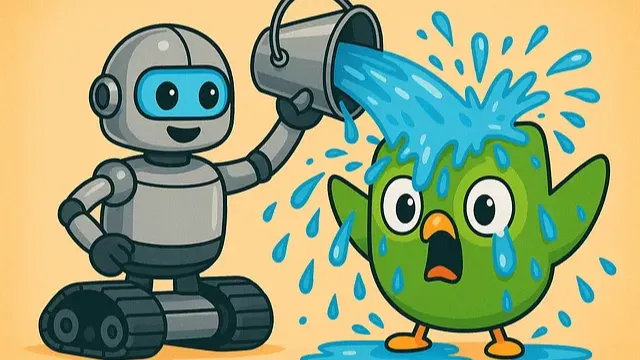
Image ironically created with AI - Design Bootcamp: AI-first at Duolingo
Introduction
AI is here to stay, but its value depends on the reasons, timing, and methods of its usage. The Responsible AI series exists to discuss precisely that - the less glamorous side of AI trends. Because you won’t 10x your performance using AI agents, nor will you “fire your development department” simply because the latest state-of-the-art model provider displayed their over-fitted benchmarks, claiming their model has already reached AGI, while still struggling to perform basic functions correctly, like telling you which year it is.
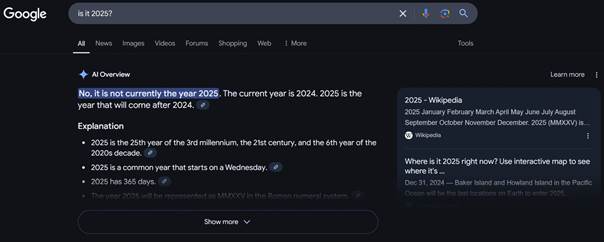
Google Gemini provides an AI Overview with incoherent and blatantly wrong information.
Quick Disclaimer
The article is aimed at AI-first companies—ones that branded themselves as such to attract attention, not AI-native companies, which were AI to begin with (e.g., OpenAI, Anthropic).
AI-First Companies & C-Suite Delusions
AI-First has become a buzzword. To the point where there isn’t one unified definition for it, so I will use the one provided by Rajesh Kandaswamy, Distinguished VP @ Gartner:
“An AI-first company prioritizes the use of AI to accomplish anything, rather than relying on established processes, systems, or tools. However, it's essential to clarify that 'AI-first' doesn't equate to 'AI-only.' Where AI falls short, we embrace traditional methods, at least for now.”
While that sounds forward-thinking and early adopting, companies like Shopify and Duolingo have misinterpreted it terribly. Why, may you ask?
The leadership teams of these companies have written internal memos that were leaked due to their absurdity. Anyone not directly involved in the respective company’s politics will recognize this as a move to stand out and appease their shareholders, demonstrating the company’s intention to be an early adopter and not "lagging." But is that a wise choice, or is it a costly decision that overlooks the human factor?
After Shopify CEO Tobias Lütke’s “AI Usage is now a baseline expectation” leaked, he decided to post the whole thing publicly.
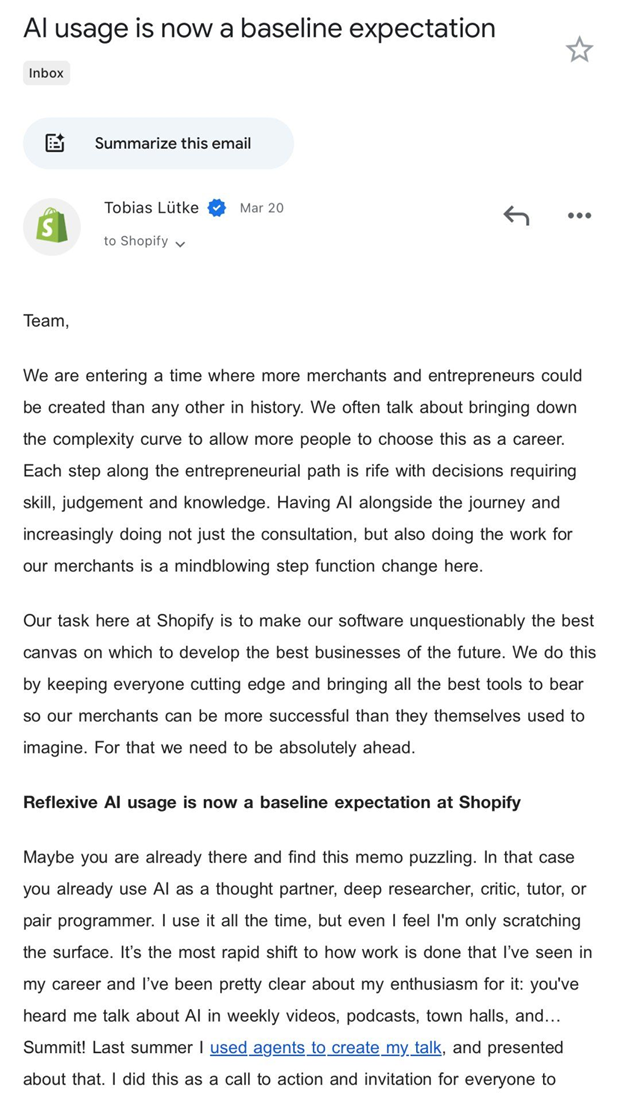
- He used AI agents to create his talk.
- Teams should show why an AI agent can’t do what a new hire would be tasked with doing. This shows a heavy buy-in on an overhyped “AI Agents” trend, which is actually a rebranded “low-code automation” in disguise.
Ask any hands-on senior or staff engineer about their honest opinion on AI Agents and the bulk of AI features. I guarantee you that a vast majority of them won’t sugarcoat that AI is riddled with tons of issues and absolute nonsensical gibberish.
Duolingo’s AI First Disaster
Original post: https://www.linkedin.com/posts/duolingo_below-is-an-all-hands-email-from-our-activity-7322560534824865792-l9vh/
CEO Luis von Ahn announced that Duolingo is going AI-first in an all-hands email. To save you the time, that means:
- “Rethink much of how we work,” where minor tweaks to systems designed for humans won’t get us there, and “…we’ll need to start from scratch,” even if it means “occasional small hits on quality than move slowly and miss the moment.”
- In a follow-up, Chief Engineering Officer Natalie Glance explained in an internal Slack message, “Start with AI for every task. No matter how small, try using an AI tool first.”
- “One of the best decisions we made recently was replacing a slow, manual content creation process with one powered by AI,” says Von Ahn.
- “We’ll gradually stop using contractors to do work that AI can handle” – which Duolingo already did in January 2024, when they cut 10% of their contractors, citing gains from AI-driven content creation.
- “AI will be part of what we evaluate in performance reviews,” marking this as a formal metric for employee evaluation.
How did that end up for them? As people would expect, horribly. “Duolingo's AI-First Disaster: A Cautionary Tale of What Happens When You Replace Rather Than Partner” outlined several faults, as mentioned in one Reddit post:
- People are rage-canceling their subscriptions.
- TikTok creators are telling everyone to delete the app
- An actual Duolingo employee made a masked video saying, "everything came crashing down".
- Now their social media just says "gonefornow123" with dead rose emojis".
Duolingo even deleted everything from their 6.7M followers on TikTok and 4.1M on Instagram. Did they learn anything from that? I will let you be the judges, since Luis von Ahn doubled down by suggesting AI would soon teach better than humans (props to groktop.us)
Summing it All Up
Based on backlash and data, the AI-first movement has failed so far, even if it only intends to appease shareholders of the company’s value.
This also happens when a company attributes the value it delivers to its end consumers to the work done during a quarter. This is because they can easily measure activities and outputs, and AI can word vomit 1000 times more and faster content than any human can.
Maybe sometime in the future, those companies will realize that their customers, buyers, are indifferent to the quantity of articles and content released, but that they deeply care about the emotional resonance and usefulness of the result, which turns into positive outcomes that truly create lasting impacts for whoever is willing to listen.
AI Transparency
To write this article, I used the following AI tools:
- OpenAI's GPT 4.5 Model for sentence rephrasing during the first few paragraphs.
- Liner's incredible proprietary model allows me to search for information apart from Googling, which I recommend over Perplexity and OpenAI's deep research. I use it to get information on reference links to support my claims. (I am not affiliated.)
- Grammarly through the entirety of this article to double-check my poor writing.
Sources (In Order
- https://www.linkedin.com/pulse/building-ai-first-company-introduction-rajesh-kandaswamy-ivn6e/
- https://x.com/tobi/status/1909231499448401946
- https://www.linkedin.com/posts/duolingo_below-is-an-all-hands-email-from-our-activity-7322560534824865792-l9vh/
- https://www.fastcompany.com/91325384/companies-adopting-ai-first-strategies-environmental-impact-duolingo-shopify
- https://www.techrepublic.com/article/news-duolingo-ai-strategy-backlash/
- https://www.groktop.us/duolingos-ai-first-disaster-a-cautionary-tale-of-what-happens-when-you-replace-rather-than-partner/
- https://www.reddit.com/r/languagelearning/comments/1kxmixs/duolingos_aifirst_disaster_a_cautionary_tale_of/
- https://www.cbc.ca/news/world/duolingo-ai-teachers-1.7539838?ref=groktop.us